

When Your Usual Workout Feels Harder: How to Train Smarter After 40

You don't have to choose between pushing through and giving up. Here's the question that actually helps. Ms. Gigglebyte — Health & Healthy Aging
October tends to reorganise things. Routines that loosened over summer firm back up. Schedules fill. The gym becomes more appealing as the days shorten. Many women use this moment to recommit — to get back to the training plan, to rebuild the habit, to return to the sessions they know work for them.
And then the plan meets the week. Monday is fine. Wednesday is harder than expected. By Friday, the workout you've done dozens of times leaves you more depleted than it should. You find yourself asking a question that sounds simple but isn't:
Should I push through, or should I skip it?
That's actually the wrong question. Not because rest doesn't matter, and not because effort doesn't matter. But because it assumes there are only two options. Most of the time, there are more.
When a Familiar Workout Suddenly Feels Different
The first useful shift is to ask a different question: Does today's workout match today's capacity?
Most fitness advice is written for the plan, not for the person in the middle of a real week. The program doesn't know that you slept badly for three nights. It doesn't account for the work project that consumed Tuesday, or the minor illness you're still shaking off, or the fact that you've been eating on the run all week. These aren't excuses. They're inputs — factors that influence how well your body can perform and recover right now.
Recovery isn't simply what happens between workouts. It's an ongoing process influenced by training load, sleep, nutrition, accumulated stress, and how much the previous sessions demanded from you. When several of these factors shift at once — and they often do, in a normal life — the gap between your usual capacity and today's capacity can widen without the workout itself changing at all.
The 2026 ACSM Position Stand on resistance training emphasises that programs should be individualised and that effective training does not require unnecessarily complicated programming. A modified session that actually happens is more useful than an ambitious session that gets skipped entirely.
Recovery Is Not the Same as Soreness
Before the framework, a useful clarification — because "recovery" gets used to mean several d
ifferent things, and treating them the same leads to poor decisions.
Delayed onset muscle soreness (DOMS) is the localised tenderness that develops 24–48 hours after exercise that challenges a muscle in an unfamiliar or more demanding way. It's common when returning to training, increasing load, or trying a new movement. Soreness is not a measure of training quality. Many effective sessions produce no soreness at all, particularly in women who train consistently. Equally, significant soreness doesn't mean the workout was particularly well-designed — it often just means the movement was new to the tissue.
Muscular fatigue is a temporary reduction in the muscle's ability to generate force. You feel it as a localised heaviness or weakness after a demanding session. It typically resolves with recovery.
General or perceived fatigue is more systemic — a feeling of being broadly depleted, heavy, or drained that extends beyond specific muscles and persists across the day. When someone says "I'm too tired to train," this is usually what they mean.
Readiness draws on all of the above: whether the planned session, on this particular day, can be performed with reasonable control, focus, and effort.
Pain is categorically different and should not be trained through. A sharp, unusual, or severe pain during exercise; joint pain that increases with movement; anything that doesn't behave like ordinary muscle soreness after a challenging session — these warrant stopping, not pushing on.
The appropriate response to each of these is different, which is why collapsing them into a single category tends to produce either unnecessary stopping or unnecessary persistence.
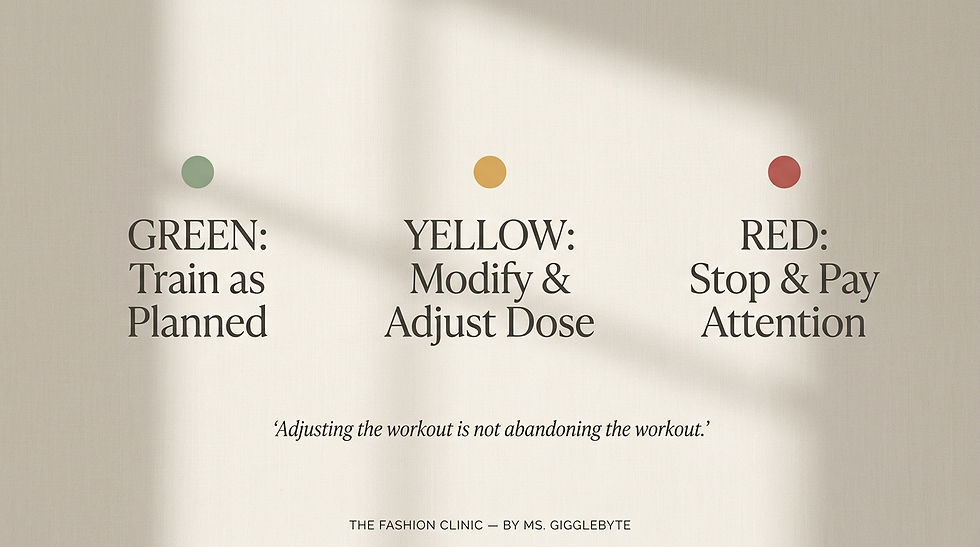
Train → Assess → Adjust
This is the practical framework the article is built around. It is not a clinical decision tool. It's an editorial self-check — a prompt for the moment before a session begins, or when a session starts to feel harder than it should.
The question at its centre: What version of training makes sense today?
🟢 Green — Train as planned
Energy feels reasonably normal. Movement feels coordinated and controlled. There's no unusual soreness preventing full range of motion and no acute illness. Nothing suggests today's session is significantly mismatched to current capacity.
Follow the plan, and progress when the session calls for it.
🟡 Yellow — Modify and continue
Sleep was disrupted or substantially shorter than usual. Energy feels lower than normal. There's more soreness or residual fatigue from the previous session than expected. Life stress — work, family, logistical demands — is meaningfully higher. Perimenopausal symptoms are affecting how you feel today. You've been eating less than usual, or you're still shaking off a minor illness.
A Yellow day is not necessarily a rest day. It's a modified training day — or possibly a rest day, depending on how Yellow it is. The principle is:
Adjust the training dose to the current capacity.
Practical ways to do that:
Reduce sets. Three sets becomes two. The movement stays; the volume decreases.
Reduce load. Use a weight you could lift for more reps than planned. The focus becomes form and control.
Stop farther from failure. If the plan was to finish a set close to your limit, stop well short of it today.
Take longer rests. Allow more time between sets. The session may run slightly longer, but the quality will be better.
Simplify. Keep the main compound movements — the squat, the hinge, the push, the pull — and remove accessory work.
Choose a more supported variation. If the planned movement feels unstable today, move to an easier variation that allows better control.
Shorten the session. Twenty minutes of quality movement is meaningfully better than zero minutes.
Substitute easier movement. When the gap between planned and capacity is wide, a deliberate walk, a gentle mobility session, or focused stretching is a reasonable substitution. It keeps the habit without accumulating load.
The concept the article wants you to carry forward:
Adjusting the workout is not abandoning the workout.
Much of the all-or-nothing thinking around training breaks down precisely at this point. Women who skip training on difficult days often do so not because a session was impossible — but because the session as planned felt impossible. A modified session was available. It simply wasn't visible as an option.
🔴 Red — Stop and pay attention
This category is not about adjusting training. It is about recognising symptoms that are categorically different from ordinary training feedback.
Symptoms that warrant stopping exercise and potentially seeking medical assessment include:
Chest pain, pressure, or tightness during or after exercise
Fainting or near-fainting
Significant or unusual shortness of breath disproportionate to the effort
Concerning palpitations — particularly alongside dizziness or chest symptoms
Significant dizziness
Sharp or severe pain
Unexplained exercise intolerance
Persistent or worsening unusual fatigue that doesn't resolve with adequate rest
These are not modification questions. They are reasons to stop, and depending on the symptom, to speak with a doctor. This distinction is worth making clearly, because the useful message about Yellow days — adjust, don't abandon — should not be applied to symptoms in this category.
What a Variable Training Week Can Look Like

The Train → Assess → Adjust framework applies not just to individual sessions, but to how a week shapes up overall.
Not every session needs to carry the same weight. A sustainable training week might include a more demanding session when readiness is good, a moderate session when capacity is lower, and an easier session or deliberate rest on a day when capacity is genuinely reduced. The specific mix will vary from week to week and from person to person.
The 2026 ACSM Position Stand is explicit that programs should be individualised based on personal goals, enjoyment, and safety. A week that produced consistent, controlled training is a productive week — regardless of whether every session matched the original plan.
What makes a training habit durable over months and years isn't that every session was maximum effort. It's that training happened, the muscles were challenged, and enough recovery occurred between sessions for adaptation to take place.
What About Perimenopause?
The menopausal transition can coincide with real changes in factors that influence how training feels for some women: sleep disruption, symptoms that affect daily energy, shifts in body composition. These experiences are genuine and shouldn't be minimised.
A 2026 narrative review published in the Journal of Cachexia, Sarcopenia and Muscle examined the evidence on menopause, female sex hormones, and muscle mass. The authors found that while the timing of menopause and changes in muscle mass appear to coincide in cross-sectional and longitudinal studies, there is a lack of high-quality evidence demonstrating a direct causal link between the two. The picture is more complicated than "declining hormones cause muscle loss," and considerably more complicated than "menopause causes slower recovery."
What this means practically: the menopausal transition doesn't produce one universal recovery pattern. Individual responses vary substantially. Some women train through this period with minimal disruption to their usual capacity. Others find that capacity becomes more variable — that what felt like a reliable Green week one month feels more like a run of Yellow days the next.
The training principle that follows from this is not "train less." It is "train responsively." Use the framework rather than the fixed plan when the fixed plan stops accurately reflecting current capacity.
What the evidence does clearly support: resistance training remains beneficial during and after perimenopause, for muscle maintenance, bone health, metabolic health, and functional independence in the decades ahead. That case doesn't weaken during the menopausal transition. For many women, it strengthens.
If perimenopause symptoms are significantly affecting your ability to train — persistently disrupted sleep, very low energy, symptoms that affect daily life — those are conversations worth having with a healthcare provider. Addressing the underlying experience may make training more sustainable rather than simply harder to sustain.
The Recovery Foundations That Actually Matter
Recovery is shaped by more than the workout.
Sleep is consistently identified as an important part of physical recovery. Consistently poor sleep can affect how rested and ready you feel for training — a factor that many women in perimenopause navigate directly.
For a deeper look at this connection, see How Sleep Affects Recovery and Muscle Health.
Protein supports muscle repair and is one of the most modifiable recovery factors available. Consistent protein across the day — not dramatic increases, just reliable presence at each meal — makes a meaningful difference.
Our 30g Protein Rule for Women Over 40 offers a practical starting point.
Overall energy intake matters more than most training advice acknowledges. Consistently under-fuelling — whether through deliberate restriction or simply not eating enough during a demanding period — can make training and recovery more difficult. The body requires adequate fuel to repair.
Accumulated training load deserves attention over weeks, not just days. Repeated demanding sessions without sufficient recovery between them can accumulate fatigue. Building in lighter periods — whether planned or responsive to how you're actually feeling — is part of sustainable training, not a departure from it.
Life stress is part of the total load even when it doesn't look like exercise. A demanding week at work or home is still part of what the body is managing. When that load is high, the appropriate training dose may be lower — not because the training program is wrong, but because the overall context has changed.
When "Listen to Your Body" Isn't Enough
This phrase appears so often in wellness writing that it has lost most of its meaning. Listen to your body — and then what?
A more actionable version: learn to distinguish between signals that suggest modification and signals that suggest attention.
Ordinary training feedback — soreness in the muscles you worked, fatigue that resolves with a good night's sleep, mild stiffness the morning after a demanding session — is the body responding normally to exercise. These signals generally call for moderation, not concern.
Different signals call for a different response. Chest symptoms during or after exercise. Fainting or near-fainting. Significant unusual breathlessness disproportionate to the effort. Sharp or severe pain that doesn't behave like muscle soreness. These belong to a different category — one that warrants stopping and, depending on the symptom, medical assessment.
Persistent fatigue that doesn't resolve with adequate rest; unexplained exercise intolerance; significant symptoms affecting daily life — these are worth raising with a doctor. They may relate to training, to nutrition, to thyroid function, to perimenopause management, or to something else entirely. The point is that these questions belong in a clinical conversation rather than a self-check framework.
A Different Question for Your Next Workout
The shift this article is asking for is modest but consequential.
Most training culture orients around: How much can I do today? The plan is set. The goal is to execute it. Anything less is a shortfall.
A recovery-aware approach asks: What training dose makes sense today — and still allows me to come back tomorrow?
These aren't competing philosophies. The second question doesn't mean training less, or holding back when you have capacity, or abandoning ambition. It means treating the relationship between training and recovery as a system — one where the workout is half of the equation, and what happens around it is the other half.
Durable training rarely comes from treating every difficult day as a test of willpower. It comes from finding a way to keep showing up — including on the days when showing up means a shorter, lighter, or different version of the plan.
That version still counts. It preserves the habit, maintains movement, and keeps the long-term training pattern intact. And the long-term total of consistent, responsive training is what produces lasting strength.
XOXO,
Ms. Gigglebyte 🧘🏽♀️🌸💕
29/09/2026
Explore more at The Fashion Clinic — practical wellness, healthy-aging and lifestyle guidance curated for women navigating midlife and beyond.
Related Reading
The 30g Protein Rule for Women Over 40: A Meal-by-Meal Guide — A practical guide to making daily protein intake easier, visible, and consistent.
The Perimenopause Protein Gap: Why You're Losing Muscle — and How to Protect Your Strength — Understanding muscle loss, anabolic resistance, and protein strategy during midlife.
Protein After 40: Essential Insights for Muscle Preservation — Why your protein needs change with age and how to structure your daily intake.
Perimenopause and Sexual Health: What Every Woman Should Know — Navigating hormonal changes, intimacy, and body confidence in midlife.
Building Unshakable Confidence After 40 — Practical mindsets for embracing strength, wellness, and self-care in your 40s and beyond.
Comfortable and Healthy Sex Positions for Midlife Wellness — Supportive and practical guidance for maintaining intimacy and physical comfort.
Sources & Scientific Reference
American College of Sports Medicine (ACSM) — Resistance Training Position Stand (Individualization and Program Design Guidelines)
Journal of Cachexia, Sarcopenia and Muscle — Research on Menopause, Female Sex Hormones, and Muscle Mass





Comments