

The Lace Blouse, Reconsidered — Why 2026's Most Romantic Trend Is Also Its Most Intelligent One

On Being Wrong About Something for Twenty Years
In the spring of 1974, I attended a dinner in Lyon at the home of a woman whose name I will not use because she is still alive and has opinions about privacy that I respect. She was in her mid-fifties at the time — which is to say she was the age I am now, though I did not understand that then — and she was wearing a lace blouse in the most precise shade of ivory I have ever seen, tucked into wide-leg trousers in warm cream, with a single tortoiseshell clip at the neck and nothing else.
I remember thinking, at twenty-nine, that it was a very beautiful garment and that it belonged on a woman of her generation rather than mine.
I was wrong. I have been wrong about this specific question, in various forms, for approximately twenty years — the years during which I associated lace with a certain kind of dressed-for-someone-else formality, with the grandmother's tablecloth aesthetic that the fashion industry spent the 1990s actively dismantling, with the bridal category where lace had been exiled and where, in my view, it could remain.
What I failed to understand was that none of those associations were properties of the lace itself. They were properties of how lace had been used — which is a different thing entirely.
2026 has corrected my understanding. And the correction is significant enough that I want to explain it in full.
What Lace Actually Is — And What It Was Never Supposed to Be
Lace is, at its technical foundation, an openwork fabric constructed from thread — historically silk, linen, or cotton — manipulated into decorative patterns. It is one of the oldest luxury textiles in European fashion history. The lacemakers of Bruges and Venice and the Alençon workshops in Normandy were producing pieces of such complexity and value in the sixteenth and seventeenth centuries that lace was literally regulated by sumptuary laws — governments attempted to restrict who could wear it based on social class, because the demand was distorting trade balances.
This is not a trivial textile. This is a fabric that European courts fought over.
What happened to it — the tablecloth association, the grandmother's curtain reputation that has haunted it since approximately 1985 — was the result of mass production. When lace became cheap and widely available in synthetic versions, the craft's historical prestige collapsed into kitsch. A fabric that had once required hundreds of hours of skilled handwork became something you could find in any discount chain, applied to any blouse in any weight, in any colour, with no consideration for proportion or quality or context.
The fashion industry's 2026 revival is not nostalgic. It is corrective. The houses that are working with lace this season — Chloé under the direction that has been transforming that house's aesthetic for the past two years, Blumarine, Dior, Saint Laurent — are working with it as a material with specific structural properties, not as a decorative shortcut.
And that is the reason it is working.
The 2026 Lace Blouse — What Is Different and Why It Matters
The lace blouses that are arriving for summer 2026 share several characteristics that distinguish them from the versions that earned the category its bad reputation.
The weight is correct. The lace being used in this season's best pieces has genuine body — not the rigid, scratchy weight of bad vintage lace, but not the whisper-thin synthetic versions that become transparent in sunlight and lose their shape after two washes. A well-made lace blouse in 2026 drapes. It holds its form. It moves with the body rather than against it.
The construction is visible. The houses that are getting this right are working with lace that has structural integrity — Chantilly, guipure, eyelet, broderie anglaise. These are laces with distinct patterns and clear construction. The alternative — the vague, uniform lace texture applied to a blouse as an afterthought — is what created the tablecloth problem in the first place. Construction-forward lace reads as deliberate. Texture-as-decoration lace reads as cheap.
The silhouette is modern. The lace blouse of 2026 is not a high-necked, fully-covered, occasion-dressing piece. It is a blouse with the same loose, slightly fluid silhouette that has been defining the broader blouse trend this season — relaxed shoulders, a neckline that sits below the collarbone, sleeves that taper without being restrictive. The lace provides the surface interest. The silhouette provides the modernity.
The palette is disciplined. The colours working hardest this season are the ones lace has always worn best: warm ivory, soft ecru, natural white, dusty rose. The fashion industry's instinct to produce lace blouses in every colour — the black lace, the cobalt lace, the forest green lace — has historically diluted the fabric's particular quality, which is its ability to diffuse light in a way that no solid fabric can replicate. A lace blouse in ivory or ecru in summer light is one of the most flattering garments available to any woman at any age. The same blouse in synthetic black polyester lace is not.
The Lace Blouse Over 40 — Why the Timing Is Correct
I want to address this specifically, because I know that some of the women reading this guide have, like me, spent a period of time avoiding lace on the grounds that it felt either too young, too dressed-up, or too reminiscent of a category of garment they had agreed with themselves never to revisit.
All three of those concerns are valid responses to lace as it has been used badly. None of them apply to lace as it is being used now.
The "too young" concern arises from the version of lace that appears in fast fashion as trim on crop tops and bodycon dresses — the lace of a very particular kind of going-out dressing. That version of lace is not what is being recommended here. A well-constructed lace blouse in ivory or ecru, worn with wide-leg trousers or a midi skirt, is not a young garment. It is, if anything, a garment that improves with the confidence of a woman who has decided what she wants to look like.
The "too dressed-up" concern arises from the bridal and occasion associations that lace acquired in the 1990s and early 2000s. The current season's lace blouses are not bridal. They are casual in the correct sense of that word — suitable for everyday wear, washable where the fabric permits, worn with jeans and flat sandals as easily as with trousers and mules. The runway lace is formal. The street-level interpretation, which is what I am recommending, is not.
The "tablecloth" concern arises from genuine aesthetic experience and should be respected. If you look at a lace blouse and see a tablecloth, the solution is not to override your instinct but to find a different piece. The lace that creates the tablecloth association tends to be: all-over uniform pattern, white rather than ivory, synthetic rather than natural fibre, applied to a blouse that is too structured and too high-necked. Avoid all four of those characteristics and the association disappears.
How to Wear the Lace Blouse — The Formulas That Work
Lace Blouse + Wide-Leg Trouser
The formula I watched work in that Lyon dining room in 1974 and have been watching work ever since.
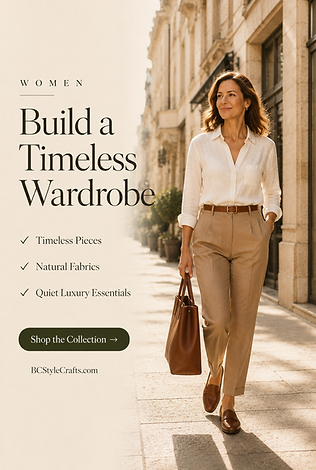
The lace blouse — loose, ivory or ecru, with visible construction — tucked into a high-waisted wide-leg trouser in warm cream, natural linen, or soft sage. Flat sandals or low leather mules. One piece of jewellery, worn with intention. This outfit requires nothing additional. It is complete.
The specific proportion that makes it work: the blouse should be slightly loose at the body, not fitted. The trouser should have enough volume that the silhouette reads as deliberate. The combination of fluid top and structured bottom creates the balance that makes both pieces look more considered than either would alone.
Shop the Look → Women's Tops · Women's Bottoms
Lace Blouse + Midi Skirt
The more dressed version, and the one with the most visual impact because the midi skirt provides movement and volume beneath the fitted line of the blouse.
The lace blouse half-tucked into a tiered or A-line midi skirt in a solid earthy tone — dusty terracotta, warm ochre, sage green. The half-tuck is important: a full tuck reads too neat, too finished, too effortful. A half-tuck reads as the natural result of someone who dressed without thinking about it too hard, which is exactly the impression that makes the outfit work.
Flat sandals. Nothing at the neck — the lace blouse provides all the detail the upper body requires.
Shop the Look → Women's Tops · Women's Dresses
Lace Blouse + Tailored Shorts
For the woman who does not wear skirts and finds the trouser too formal for summer. High-waisted tailored shorts in linen or cotton — not denim, not athleisure, not frayed — with a lace blouse tucked in and flat leather sandals.
The shorts must be properly tailored: a real waistband, real pockets, a hem that sits at mid-thigh or just above the knee. The lace blouse provides the softness that keeps the look from reading as overly structured. The tailored shorts provide the crispness that keeps the lace from reading as too dressed-up.
Shop the Look → Women's Tops · Women's Bottoms · Summer Sandals & Jelly Flats
Lace Blouse + Jeans — The Everyday Version
The most wearable formula and the one that will carry the lace blouse through the greatest range of contexts.
A slim or straight-leg jean in a clean mid-wash or dark indigo — nothing distressed, nothing cropped too aggressively — with a lace blouse in ivory tucked in at the front and left loose at the back. White leather sneakers or flat leather sandals. A bag in natural leather or woven straw.
This is the outfit that the French women who have been wearing lace correctly since approximately 1968 wear to the market, to lunch, to the school run. It does not announce itself. It simply looks right.
Shop the Look → Women's Tops
What to Avoid — Three Mistakes That Create the Tablecloth Problem
Avoid synthetic lace above 50% polyester content. The tablecloth association comes almost entirely from synthetic lace — the kind that has a slightly plastic sheen, that does not drape naturally, that pills after washing. Natural fibre lace, or a blend with significant cotton or modal content, behaves entirely differently. Read the label before you buy.
Avoid lace that is all-over and uniform. The lace that works has structure and pattern variation — areas of density and areas of openness that create visual interest. Uniform all-over lace, particularly in synthetic versions, reads as texture-applied-to-a-surface rather than fabric-with-its-own-character. The distinction is visible and it matters.
Avoid wearing lace on lace. A lace blouse with a lace trim skirt, or a lace top with a lace cardigan, compounds the fabric's delicacy into excess. One lace piece per outfit. Everything else should be in a solid, natural-fibre fabric that lets the lace speak without competition.
What the Woman in Lyon Was Right About
I have thought about that dinner in 1974 while writing this guide.
What she understood — and what I was twenty years too young and too certain of my own judgement to understand — was that the lace blouse is not a formal garment pretending to be casual, or a casual garment pretending to be formal. It is a garment that occupies the space between those two categories, and that space, worn with the right confidence and the right simplicity around it, is one of the most elegant places in a wardrobe to stand.
She was fifty-five. She had earned the right to wear it exactly as she pleased.
So have you.
— Shop the Look —
Free shipping across the US & Canada.
— Sassy 💁♀️
1/May/2026




Comments