

Summer 2026 Outfits for Women — Sassy's Complete Style Guide

A Confession Before We Begin
I have been dressing for summer for fifty-five years.
I have dressed for summer in Florence, where the stone absorbs the heat and releases it back at you on your way home from dinner, and you learn very quickly that polyester is your enemy. I have dressed for summer in Lyon, where the Rhône creates a humidity that will ruin a structured linen blazer before you have finished your first coffee. I have dressed for summer in Nice, where the light is so particular, so silver and gold at the same time, that the wrong colour can make you look like a ghost or a bruise depending on which way the mistral is blowing.
I have made every mistake. The wrong fabric on the wrong day. The beautiful dress that looked magnificent in the boutique and became unwearable by noon. The perfectly curated "summer capsule" that sat in my wardrobe untouched because it did not account for the actual reality of my actual life in the actual heat.
So when I tell you what to wear this summer — when I tell you about Summer 2026 outfits, as the search engines and trend reports and endless content machines seem to want me to call them — I want you to understand that what I am offering you is not a mood board. It is not an algorithm's output. It is fifty-five years of trial, error, observation, and the occasional absolute triumph, distilled into the clearest guidance I can give you.
Let us begin.
Why Summer 2026 Is Different — And Why That Matters
Every season, the fashion industry performs a particular theatre. It announces that this season is unlike any other. That the rules have changed. That what you owned last year is no longer sufficient.
I do not participate in this theatre.
But I will say this: Summer 2026 is genuinely interesting in a way that the last three summers were not. And the reason is not complicated. After several years of fashion lurching between maximalism and the kind of minimalism that looked like it was trying too hard to be calm, something has settled. The silhouettes have found their sense again. The fabrics are, for the first time in a while, behaving like fabrics rather than performance materials pretending to be clothes. And there is a colour palette emerging this summer that I have not seen so coherently since I was sitting on the steps of a palazzo in Florence in the summer of 1970, watching the city dress itself for the heat.
I am paying attention. You should too.
The Silhouettes of Summer 2026 — What They Are, Why They Work, and What They Are Actually Doing to the Body
The Tiered Midi and the Question of Proportion
I want to begin with the tiered midi dress, not because it is new — it is not, and anyone who tells you otherwise is trying to sell you something — but because Summer 2026 has done something genuinely clever with it, and I think it deserves a proper examination.
The tiered midi has been with us for several years now, and in those years it has suffered from a specific problem: the tiers were too uniform. Equal depths, equal volumes, stacked like a slightly romantic wedding cake. The result was a dress that worked beautifully on certain bodies and created a horizontal emphasis on others that was, to put it diplomatically, not always ideal.
This summer, the proportions have shifted. The tiers are deeper at the hem, more gathered, more voluminous at the base — while the bodice has become more fitted, more controlled. What this creates is something I have not seen in ready-to-wear since the late 1970s, when the Italian houses were doing their most interesting work with skirt construction: a silhouette that reads as genuinely fluid. That moves with the body rather than around it. That creates the impression of ease without actually being shapeless.
The technical term for what is happening in the construction is that the ratio of the tiers has shifted from approximately 1:1:1 to something closer to 1:1.5:2.5, bottom-heavy. This sounds like a small adjustment. In practice, on a moving body, it changes the entire visual vocabulary of the garment.
For women over 40, this proportion shift is particularly good news. The added volume at the hem creates length. The fitted bodice creates structure. The movement is generous without being overwhelming. If you have been wearing tiered midis for two years and found them serviceable but not particularly flattering, I would encourage you to try the 2026 proportion before you dismiss the silhouette entirely. It is a meaningfully different dress.
Shop the look: Women's Dresses→
The Wide-Leg Trouser — The One I Have Been Wearing Since 1972
I am going to make a confession that may irritate some of my colleagues in the fashion world.
The wide-leg trouser in a fluid fabric — linen, viscose, or a blend of the two — is not a trend. It has never been a trend, in the sense of something that appears and disappears. It is a solution. It was a solution in 1972 when I first wore a pair of wide-leg linen trousers to a textile conference in Bologna and spent the entire day being comfortable while everyone else sweated through their tailoring. It was a solution in 1985 when wide-leg trousers temporarily fell from fashion and I wore them anyway. It is a solution now.
What makes a wide-leg trouser the correct summer garment is not aesthetics, though the aesthetics are often excellent. It is physics. A wide leg creates air circulation. A fluid fabric does not trap heat against the skin. A high waist — and the summer 2026 iterations are predominantly high-waisted — holds the garment in place without the waistband digging in as temperatures rise and waistlines expand by the end of a long lunch.
The pairing that I recommend absolutely, without hesitation, for Summer 2026: wide-leg trousers in washed linen or linen/viscose blend, with a camisole or fitted sleeveless top tucked in. Not a blouse — a blouse adds volume at the waist that the trouser does not need. A camisole. Thin straps, good fabric, enough structure to hold its shape in heat.
The colour combination that I find most compelling this summer is warm ivory trousers with a sage or dusty terracotta camisole. This is not an accident. These are the colours of Southern European summer — of walls in Siena, of old linen drying in the sun, of terracotta pots on stone steps in July — and they are colours that work with virtually every skin tone in warm light, which is the light you will most often be standing in.
Shop the look: Women's Bottoms→ · Women's Tops →
The Mini Dress — How to Wear It When You Are Thirty, Forty, Fifty, Sixty and Beyond
I turn sixty-something this year, and I still own three mini dresses. I say this not to boast, but because I have noticed a particular tiresome tendency in fashion advice directed at women over a certain age, which is to suggest that the mini dress is no longer available to them. That there is a precise moment — some writers imply forty, some fifty, some seem to believe it is the day you have a child — at which the mini dress must be surrendered.
I reject this completely, and I rejected it in Nice in 1978 when I wore a navy halter mini to a dinner party and a woman ten years my senior told me I would regret it, and I rejected it in Rome in 1991 when I wore a silk mini to a fashion industry reception and the reaction suggested that fashion people, of all people, should have known better than to have an opinion about what I put on my body.
The summer 2026 mini dress is worth discussing, however, because it is a genuinely well-constructed thing, and the construction matters as much as the question of whether to wear it.
What I am seeing this summer — and what I recommend — is the mini dress with a smocked or elasticated bodice, a tiered or ruffled skirt, and a halter or square neckline. This is not the paper-thin, shapeless mini of the fast fashion market. This is a mini dress that has structure in the bodice, movement in the skirt, and a neckline that frames the shoulders and collarbone rather than simply existing somewhere in the vicinity of them.
The fabric question for the mini dress this summer is important. A mini dress in polyester will, in temperatures above twenty degrees, become a small personal sauna. A mini dress in cotton, rayon, or a cotton/modal blend will breathe. I cannot stress this enough. The difference between a summer outfit that works and a summer outfit that fails is almost always the fabric, and nowhere is this more true than in the mini dress, where the brevity of the garment means there is very little of it doing a great deal of work.
Shop the look → Women's Dresses
The Fabric Truth — What to Buy, What to Leave, and What the Labels Are Not Telling You
I spent eleven years working in and around textile manufacturing and quality assessment. I have held more fabric samples than most people have had hot dinners, as my mother used to say. I have stood in production facilities in Italy, France, Portugal, and Turkey and watched fabric move from fibre to finished garment. What I know about fabric, I know at the molecular level.
Let me translate that into something useful for your summer shopping.
The Blended Fabric Revolution — Why Now, and Why It Matters
The most significant development in summer fabrics over the last three years has not been a new fibre or a new technology. It has been the wide market adoption of intelligently designed blends — linen/viscose, cotton/modal, bamboo/Tencel — that combine the best properties of two natural or semi-synthetic fibres.
Pure linen is magnificent. It breathes better than almost any fabric in existence. It ages beautifully. It has a quality of texture — what textile people call "hand" — that feels, in warm weather, genuinely pleasurable against skin. But pure linen creases. It creases heroically, enthusiastically, as though creasing is its primary ambition. By the time you have sat through a two-hour lunch in pure linen trousers, you will appear to have slept in them.
Pure viscose drapes exquisitely. It falls like water and moves like a liquid, which is why it is so prevalent in summer dressing. But pure viscose clings when you perspire. It loses its shape in humidity. It can, in the wrong weight, become almost translucent when damp.
The linen/viscose blend — typically 55% linen, 45% viscose, though the proportions vary — gives you the breathability and texture of linen with the drape and recovery of viscose. It creases, but gently. It drapes, but not clingly. It is, for summer dressing, the most intelligent fabric available in the mid-price range, and it is increasingly available at accessible prices. Look for it specifically. Read your labels.
The Polyester Problem — A Direct Conversation
I am going to be direct about polyester, because I think the fashion industry has been somewhat dishonest about it for twenty years.
Polyester is not breathable. It cannot be made breathable. No treatment, no weave, no "technical" formulation changes the fundamental fact that polyester is a petroleum-based synthetic polymer that does not allow moisture vapour to pass through it at the rate that natural and semi-synthetic fibres do. When you wear polyester in summer, your body produces heat and moisture, and that heat and moisture has nowhere to go. It sits between the fabric and your skin.
I say this not to be difficult, but because I have watched women stand in shops holding beautiful summer dresses that feel, under store air conditioning, like perfectly reasonable garments — and I have watched those same women spend their summers uncomfortable, damp, and wondering why their clothes don't feel the way they looked on the rack.
Check the label. If a garment is above 60% polyester, consider whether you will be comfortable wearing it in the actual temperatures of your actual summer. A garden lunch. A long dinner. A walk through a city in July. This is the test.
The exception: a structured polyester-blend blazer or jacket, worn as a layer, removed when the temperature rises. As a layer over natural fibre underlayers, polyester is manageable. As the garment closest to your skin in summer heat, it is not your friend.
The Summer 2026 Colour Palette — What I Saw, Where I Saw It, and What It Means For Your Wardrobe
In the spring of 1970 I arrived in Florence for a six-month position at a textile house and I fell, immediately and completely, in love with the colour of the city in summer.
Florence in July and August is not the Florence of postcards. The tourists have arrived but the city beneath the tourism carries on — the laundry drying between windows, the cats on warm stone, the shutters half-closed against the afternoon light, the aperitivo colours of the hour before dinner. And everything, everything, is the colour of old terracotta, of dust, of warm white, of the green that appears in old stone when moss takes hold in the shadows.
I describe this at length because Summer 2026 has, quite specifically, returned to exactly this palette. And not in a fashion-trend way — not in the way that a colour "has a moment" and then disappears. In a deeper way. In the way that this palette has always worked, and the industry has simply remembered.
Warm White and Ivory
The most versatile colour in any summer wardrobe. Not stark white — stark white reads, in summer light, as either very fresh or very harsh depending on your skin tone and the quality of the fabric. Warm white — the slight cream of unbleached linen, of old silk, of milk — works in every light, in every context, with every skin tone.
I own four ivory-toned summer garments. They work harder than anything else I have. They work harder than any statement piece, any print, any deliberately chosen "interesting" colour. The ivory camisole under wide-leg terracotta trousers is the outfit I reach for most often in summer, and it will continue to be.
Dusty Terracotta
Not orange. Not rust. Not the saturated, demanding terracotta of a few years ago that required a very specific skin tone to carry. The specific dusty, slightly faded terracotta that appears on old Mediterranean walls — the colour of clay after it has been in the sun for a hundred years. This is the colour of Summer 2026, and it is a colour that I find genuinely accessible: it warms cool undertones, complements warm ones, and works in both light and dark fabrics.
A dusty terracotta tiered midi. A dusty terracotta wide-leg trouser. A dusty terracotta linen camisole under ivory or sage. All of these are outfits.
Sage Green
The third colour in this palette, and the one with the longest legs — sage green has been building steadily for four years and is now fully established as a summer neutral. It is not a statement colour. It is a colour that recedes — that allows the person wearing it to be the thing you see, rather than the garment.
Sage green wide-leg linen trousers are, I would argue, the single best investment you can make in your summer wardrobe this season. They work with ivory, with warm white, with terracotta, with soft blue. They work with gold jewellery and with silver. They work for brunch and for dinner and for every occasion in between.
Soft Cobalt
The one colour in this palette that asks something of you. Not the sharp, electric blue of sportswear. Not the muted navy of professional dressing. The soft, slightly warm cobalt that appears in Mediterranean tilework and ceramic and Italian glazed pottery — a blue that contains a small amount of green and a small amount of warmth and is, as a result, one of the most forgiving blues available.
A soft cobalt halter mini dress with flat sandals and a small straw bag is the summer 2026 evening outfit that I find most compelling. It requires very little else. Minimal jewellery. Neutral shoes. The colour does the work.
Three Complete Summer 2026 Outfits — Constructed, Not Assembled
I want to make a distinction that I consider important: the difference between a constructed outfit and an assembled one.
An assembled outfit is a collection of items that do not conflict. A constructed outfit is a collection of items that work together as a deliberate whole — where the proportions speak to each other, the fabrics have a visual conversation, the colours create a coherent light.
Everything I recommend below is a constructed outfit. Each piece has been chosen in relation to the others.
Outfit One — The Florentine Tuesday
This is the outfit the woman on the Via de' Tornabuoni wore every Tuesday in 1970, and it is an outfit that will look as correct in 2026 as it did then, because it is based on principles rather than trends.
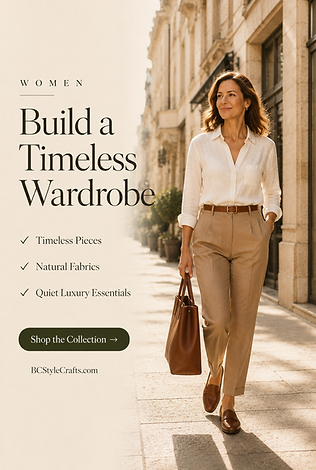
Ivory or warm white wide-leg linen/viscose trousers, high-waisted. Sage or dusty terracotta fitted sleeveless top or camisole, tucked in cleanly. Flat leather sandals in a warm neutral — not white, not black, the specific tan or camel that reads as a non-colour. A structured tote in natural straw or woven leather. Small gold hoops, nothing larger. Oversized sunglasses with a warm frame.
This outfit works for a city in summer. It works for a garden. It works for a market and a museum and a long lunch. It requires very little thought once you have assembled the pieces, because the proportions are stable and the colour palette coheres.
Shop the Look: Women's Bottoms→ · Women's Tops→ · Summer Sandals & Jelly Flats→ · Women's Bags→
Outfit Two — The Garden Party Dress
The tiered midi in dusty terracotta floral print — the print should be small-scale, botanical rather than graphic, the kind of print that reads as texture from a distance and reveals itself as pattern close up. A low block-heeled mule in a warm neutral. A structured mini bag — not a tote, not a clutch, the shoulder bag that sits against the hip and holds your phone and your lipstick and nothing else. Oversized sunglasses. A single layered necklace or statement earrings — one or the other, not both.
This outfit is for the occasion that requires you to look considered without looking formal. The garden wedding. The rooftop birthday. The lunch that begins at noon and ends at six. It photographs beautifully from every angle because the tiered midi creates movement in the photograph that static garments cannot.
Shop the Look: Women's Dresses→ · Women's Shoes→ · Women's Glasses & Eyewear→ · Women's Jewelry & Accessories→
Outfit Three — The Beach Town Dinner
The cobalt halter mini dress in a cotton/modal blend — the fabric question matters here, as the mini dress must be comfortable through a dinner and an evening walk. Flat strappy sandals in gold or warm tan. A simple gold chain necklace, close to the neck. A one-strap shoulder bag in a neutral that does not fight the cobalt.
Nothing else. This outfit does not want editing. The colour is the statement. Everything around it must be quiet enough to let it be heard.
Shop the Look: Women's Dresses→ · Summer Sandals & Jelly Flats→ · Women's Jewelry & Accessories→ · Women's Bags→
The Question I Am Always Asked
Every year, at some point in the spring, someone asks me the same question in approximately the same words: "What is the one thing I should buy for summer?"
And every year I give the same answer, which is not the answer they are expecting.
The one thing I would buy for summer is not a garment. It is a roll of heat-appropriate fabric from a well-made blend, cut and sewn into the silhouette that most flatters and most comforts you personally. But since most of you do not have the option of commissioning your summer wardrobe — and since I am not living in 1968 anymore, and even then most people did not commission their clothes — I will translate this into something practical.
The one thing to buy for summer is the garment that solves the problem of your particular life. Not the garment on the trend report. Not the garment the influencer is wearing. The garment that answers the question: what do I need to wear, for the places I actually go, in the heat I actually feel, with the body I actually have, so that I can stop thinking about what I am wearing and simply live my summer?
That is the garment worth finding. Everything I have told you today is in service of helping you find it.
Go, darling. The summer is waiting.
— Shop the Look —
Free shipping across the US & Canada — because spring should not come with a delivery fee.
— Sassy 💁♀️
18/Apr/2026




Comments